What the Heck is Bokeh?
There is much written on the net about this elusive subject, and I won't attempt to provide the etymology of the word (is it Japanese or not?) to compete with it. Suffice to say that different lens designs have an effect on the appearance of the out-of-focus areas in photographs.
Some photographic styles commonly use selective focus to bring the viewer's attention to the subject. That means the subject is focused but the non-subject areas are not. If those unfocused areas are busy and distracting, the objective of bringing attention to the subject is lost. That's why portrait photographers in particular care about bokeh.
There are a couple of myths about bokeh:
- Bokeh is controlled by the roundness of the lens diaphragm.
- Faster lenses have better bokeh.
Both of these are, at the very least, not the whole story, as we will see.
An out-of-focus highlight will be represented as a disk. If that disk is uniformly bright, the bokeh is, in my opinion, neutral. This is common with highly corrected prime lenses. The literature suggest that over-correction of spherical aberration causes the disk of the out-of-focus highlight to have a bright edge. I call this bright-edge bokeh, and it's a close cousin of another distracting effect, known as double-line bokeh, where out-of-focus linear details are rendered as parallel lines. These are examples of poor bokeh.
Lens designs that provide good performance but leave a residue of uniformly under-corrected spherical aberration produce a disk with a faded edge, that I call soft-edge bokeh.
Some lens designs are associated with good bokeh, while others are associated with poor bokeh. The three lens types that are usually found in normal and short telephoto lenses are the traditional Tessar, a double-gauss design like the Planar, and the traditional Sonnar. Sonnars are thought to have the best bokeh, while Tessars are described over and over again as having "clumpy" bokeh that is acceptable to some and not to others. Double-gauss lenses are hard to pin down. Some double-gauss designs have reputations for terrible bokeh, like the Shneider Xenotar, and others are famous for good bokeh, like the Canon Serenar 50/1.8 that was used on their rangefinder camera back in the 50's and 60's.
The Tessar design is a refinement of the old triplet design. It minimizes chromatic aberration and provides good sharpness, but does not perform really well at wide apertures. It used few elements (only two or three groups), so it worked well in uncoated lenses. The Planar/double-gauss design is quite old--over 100 years--but it required 6 elements in at least four groups. Performance without anti-reflection coatings was poor, with lots of flare. So, this design did not gain in popularity until lens coatings were used. The Sonnar design was intended to provide excellent wide-aperture performance without so many air surfaces. The first really fast normal lenses were Sonnar designs, and even as late as the 50's most fast normals were variations of it. But the Sonnar design had a fault when used as a normal: The glass got too close to the film and did not allow room for a reflex mirror. Thus, the Sonnar design could not be used for normal lenses in single-lens reflex cameras what had a mirror box between the lens and the film.The Sonnar design has therefore shifted to longer focal lengths where sufficient clearance could be attained.
In the last couple of decades, lens design has enjoyed a couple of breakthroughs. One is computer optimization, using the modulation transfer function instead of ray-tracing. MTF provides a measure not only of acutance and resolution, but also how they interact with contrast to accurately represent fine detail in the photograph. The other breakthrough is low-dispersion and high-refractive glass. These two breakthroughs, coupled with advanced multi-coatings, have made complex designs possible, especially in with zoom lenses.
Lenses Tested
To demonstrate and compare bokeh, I have assembled a range of lenses all in the 120-135mm focal length. These are commonly used as short portrait lenses in medium format and long portrait lenses in 35mm. (They are very long for portraits using an APS-sized sensor, but the longer working distance proves to be important in keeping depth-of-field narrow). I chose this focal length for several reasons: 1.) it sits between the popular 80-100mm range in small cameras and the 150-180 range in medium-format cameras, and thus I could throw in some examples from those categories without the change in focal length ruining any hope of comparison. 2.) This focal range is considered a working portrait range in both small and medium-format cameras, and so lenses in this range are more likely to be designed with good bokeh in mind. 3.) I happened to own a wide variety of lenses in this range, including at least one example from the three major lens designs described above.
The lenses in the test are as follows:
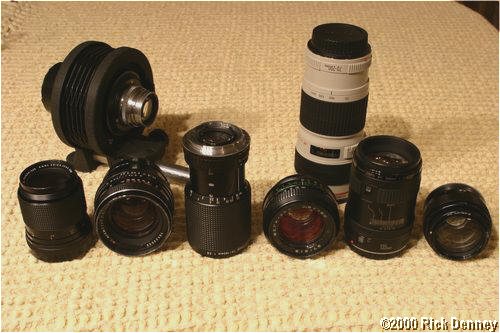
Lens Lineup (from left): Zeiss Jena 135 Sonnar, B&L Tessar on Pentacon Six bellows, Zeiss Jena 120 Biometar, Nikkor Series E 75-150, Vega 120, Canon 70-200/4L, Canon 135SF, and Jupiter 9 85/2
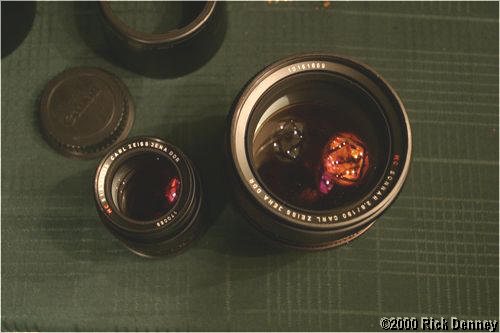
Zeiss Jena 180/2.8 Sonnar added to the test, here compared with the 135/3.5 Sonnar. It's heavy in addition to being big.
| Lens Description | Comments |
| 135mm f/3.5 Carl Zeiss Jena MC-Sonnar |
M42 mount and adapted to Canon EF. This lens is a four-element Sonnar design with multicoating, and was intended for use in Practika and Pentacon 35mm cameras made in the former East Germany. Produced in the 1980's, but designed in 1965. |
| 139mm f/4.5 Bausch and Lomb Tessar |
A barrel lens mounted on a Pentacon Six bellows, which are adapted to Canon EF. This lens is by far the oldest in the test. It's a pre-war uncoated lenses intended for use on enlargers. Enlarger lenses would not be expected to be optimized for bokeh, and this lens does nothing to refute that assertion. I use it for copy work in medium format. Produced in the 1930's. |
| 120mm f/2.8 Carl Zeiss Jena MC-Biometar |
This five-element double-gauss lens is a variation on the Planar design. The diaphragm was malfunctioning on this lens and so it was tested only wide open. The mount is Pentacon Six medium format, adapted to Canon EF. Produced in the 1980's from a 1950's design. Many buy this lens to escape the often poor bokeh of the Vega (see below), but is it really better? |
| 75-150mm f/3.5 Nikon Series E |
The Nikon EM was intended to be a low-cost entry into the SLR market many years ago. The Series E lenses for it were also targeted to a low price point, which is why they are not Nikkors. I included it because when it comes to bokeh, assumptions without testing are dangerous, and it might turn out to be a gem. It has a Nikon AI mount, but I have an adaptor. The lens dates probably from the early 80's, and I expect the design was a stock design in the Nikon lens range. It's a good lens to test whether lens complexity means bad bokeh, especially if the lens is cheap. |
| 120mm f/2.8 Arsenal (Kiev) Vega MC |
Arsenal is a Ukrainian manufacturer, and also produces the Kiev line of cameras. The lens is a double-gauss design with six elements in four groups. It is known for being sharp, and in some circumstances for producing unsatisfying bokeh. It's in an Pentacon Six mount. The Vega is likely a 70's or earlier design, and the lens dates from the 80s. |
| 70-200mm f/4L Canon L-series |
This is a highly regarded L-series premium zoom lens from Canon, designed in the late 1990's. It is by far the most expensive lens in the lineup, but also the most complex with 14 elements. |
| 135mm f/2.8 Canon Soft-Focus |
The soft-focus effect on this lens seems to be switchable spherical aberration. I find the effect unsatisfying, but the lens is still quite usable with the soft-focus switched off. It's faster than the Zeiss Jena 135 at the top of the list, but is it better? This lens was designed in the 80's or 90's. |
| 85mm f/2.0 LSOZ Jupiter-9 MC |
This lens is a copy of a Sonnar, and is made in Russia for use on Zenit cameras with an M42 mount. It has a preset aperture with many blades and produces a round aperture at all settings. A proper test of this lens would compare it with the Canon 85/1.8, which is known for good bokeh, and various 80mm medium-format double-gauss lenses. I'll save that for a future test. |
| 180mm f/2.8 Carl Zeiss Jena MC-Sonnar |
This medium-format portrait telephoto is perhaps the most classic of all Sonnars, being a direct descendent of the original Olympia Sonnar developed for us in the 1936 Olympics. F/2.8 is quite fast at this focal length, and with coverage for medium format, the lens is quite large. I included this lens to compare it with the Canon 70-200/4L zoom, and to compare it with the faster (f/2.8) lenses in the test. It is famous in medium-format circles for having outstanding bokeh, and even non-photographers can pick images made with this lens out of a crowd. |
Test Scenarios
Test conditions include a near item that would serve as a focus target. A far item would provide a sampling of out-of-focus details to provide the comparison. There were three test scenarios. The first is a wine bottle used as a focus target, with a crystal wine glass and crystal candlestick in the background. The facets of the crystal provides a range of out-of-focus highlights. This test was conducted at f/4 for all the lenses (except the Tessar, at f/4.5). This test did well for looking at out-of-focus specular highlights, but did not reveal general rendering of out-of-focus backgrounds clearly.
The second scenario used a small Hopi Kachina doll as the focus target. A larger doll in the background tested out-of-focus patches of color and a range of details. A glass vase next to the doll in the background provided some out-of-focus specular highlights. I used a striped Mexican blanket as a background to provide out-of-focus linear elements. This test was conducted at f/4 and at f/11. This test gave different results, demonstrating that lenses perform differently in different scenarios. To render the background Kachina doll more out of focus, a third scenario was set up.
The third scenario is a slight variation of the second, to get the items within the field of view and minimum focus distance of the 180mm Sonnar, and to put the background doll more out of focus. This test was conducted at f/4 only with the Sonnar and the Canon 70-200/4L zoom, and then it was repeated with a selection of the lenses at their maximum apertures.
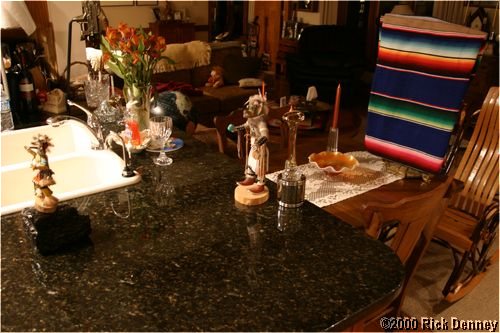
Scenario 3 Subject arrangement. Camera was about four feet to the left of the frame.
Lighting for all tests was the same: A bank of tunsten floodlights to provide plenty of specular highlights.
The camera was a Canon 10D 6-megapixel digital camera with a 15x23mm sensor. 135mm is nearly five times the normal focal length of 28mm for this format. White balance was set to tungsten (2800 degrees Kelvin). Images were shot in raw mode, and batch converted with no processing to high-quality JPEG files of 500x333 pixels. There are some JPEG artifacts in the images, but the JPEGs do not lead me to different conclusions than the original images. The camera was mounted on a very sturdy Bogen tripod (the largest in Manfrotto's line and intended for large-format view cameras). Exposure times were generally 1/8 second at f/4, 1 second at f/11, and 1/15 at f/2.8, with an ISO setting of 200.
Test Scenario 1, Wine Glass at f/4.
| 135/3.5 Zeiss Jena MC-Sonnar |
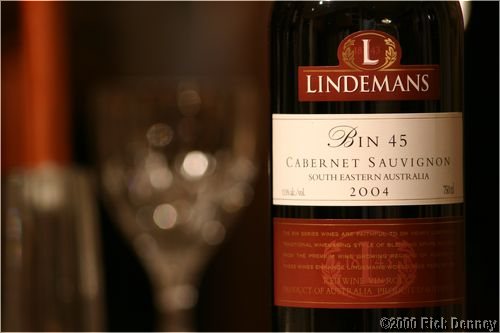 |
Edge: Slight bright-line Double-line: None Aperture shape: Slight Overall effect: Pleasing |
| 139/4.5 Bausch and Lomb Tessar |
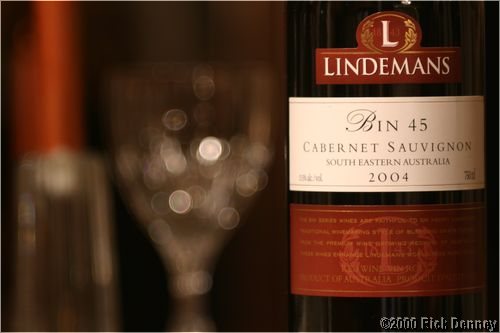 |
Edge: Pronounced bright-line Double-line: Apparent Aperture shape: None Overall effect: Distracting
|
| 120/2.8 Zeiss Jena MC-Biometar (at f/2.8 due to faulty aperture) |
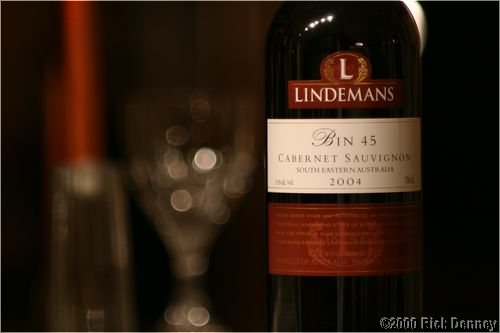 |
Edge: Pronounced bright-line Double-line: Apparent Aperture shape: Slight Overall effect: Distracting |
| 75-150/3.5 Nikon Series E (at ~135) |
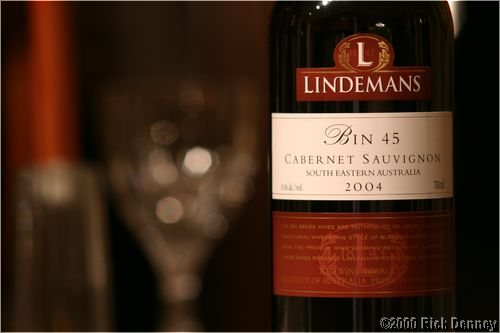 |
Edge: Very slight bright-line Double-line: None Aperture shape: Slight Overall effect: Pleasing
|
| 120/2.8 Arsenal Vega MC |
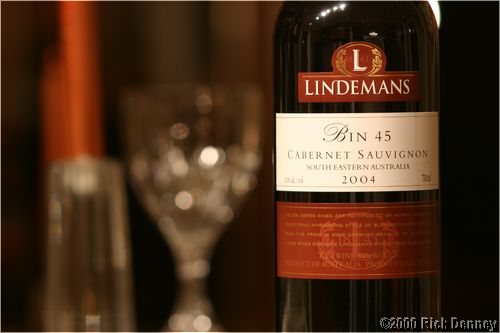 |
Edge: Slight bright-line Double-line: Apparent Aperture shape: Slight Overall effect: Neutral
|
| 70-200/4L Canon (at ~135) |
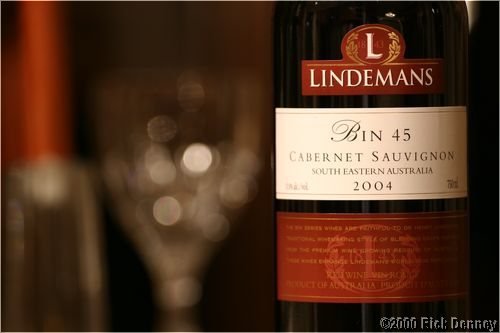 |
Edge: Slight bright-line Double-line: Slight Aperture shape: None (lens is wide open) Overall effect: Pleasing
|
| 135/2.8 Canon (no SF) |
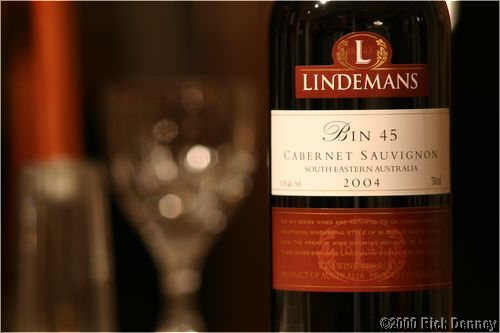 |
Edge: Slight bright-line Double-line: Slight Aperture shape: Slight Overall effect: Neutral
|
| 85/2 Jupiter |
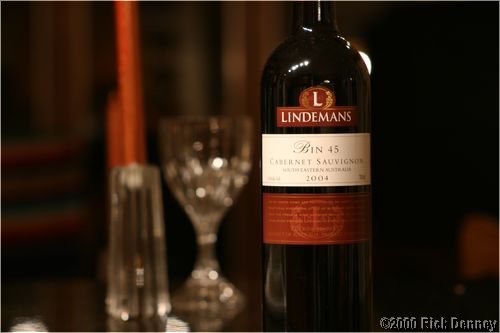 |
Edge: Slight bright-line Double-line: None Aperture shape: None Overall effect: Pleasing
|
Test Scenario 2, Kachina Dolls at f/4
| 135/3.5 Zeiss Jena MC-Sonnar |
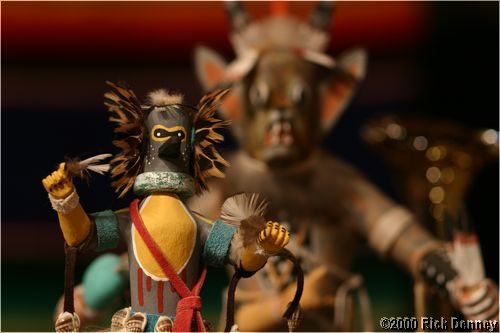 |
Edge: Very slight bright-line Double-line: None Aperture shape: Very slight Overall effect: Pleasing |
| 139/4.5 Bausch and Lomb Tessar |
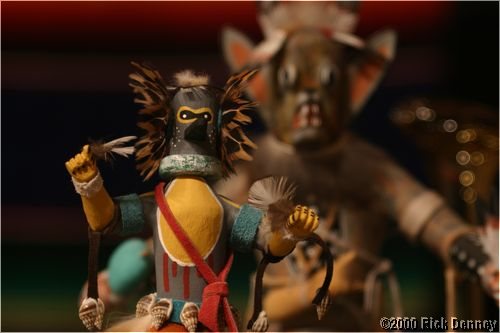 |
Edge: Pronounced bright-line,
with bright center dot Double-line: None Aperture shape: None Overall effect: Distracting
|
| 120/2.8 Zeiss Jena MC-Biometar (at f/2.8 due to faulty aperture) |
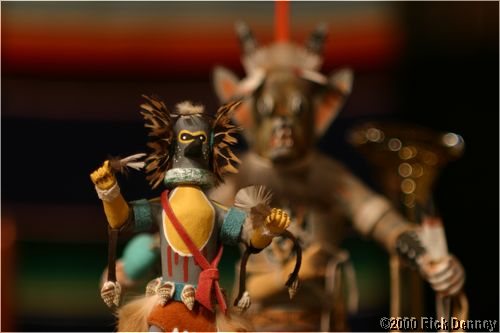 |
Edge: Pronounced bright-line Double-line: Apparent Aperture shape: None Overall effect: Distracting |
| 75-150/3.5 Nikon Series E (at ~135) |
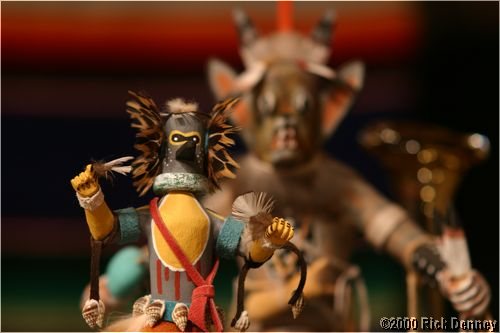 |
Edge: Very slight bright-line Double-line: None Aperture shape: Slight Overall effect: Pleasing
|
| 120/2.8 Arsenal Vega MC |
 |
Edge: Slight bright-line Double-line: None Aperture shape: Slight Overall effect: Neutral
|
| 70-200/4L Canon (at ~135) |
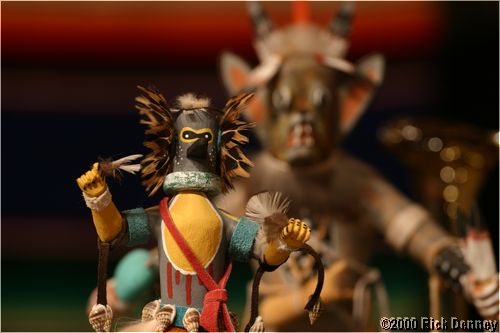 |
Edge: Slight bright-line Double-line: Slight Aperture shape: None (lens is wide open) Overall effect: Pleasing
|
| 135/2.8 Canon (no SF) |
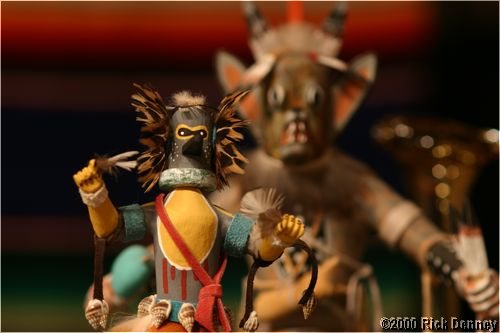 |
Edge: Slight bright-line Double-line: Slight Aperture shape: Slight Overall effect: Neutral
|
| 85/2 Jupiter (at f/2 to provide similar apparent focus) |
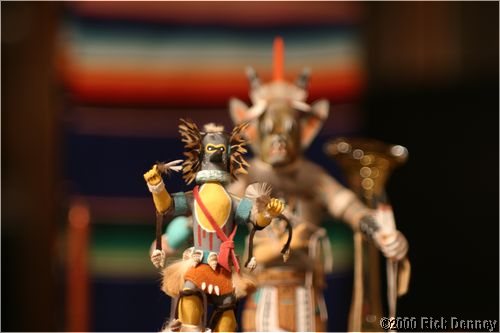 |
Edge: Pronounced bright-line Double-line: Apparent Aperture shape: None Overall effect: Distracting
|
Test Scenario 2, f/11
Out of focus details were too small to assess edge effects. They could be seen at full enlargement, but were not apparent and normal viewing distances and therefore I decided they were not important. Instead, in this section, I'm curious whether there is much noticeable difference between lenses when the background is only a little out of focus.
| 135/3.5 Zeiss Jena MC-Sonnar |
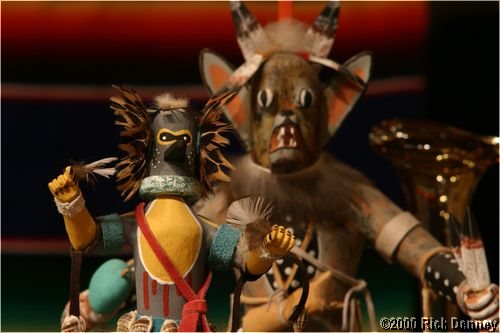 |
Overall effect: Pleasing |
| 139/4.5 Bausch and Lomb Tessar |
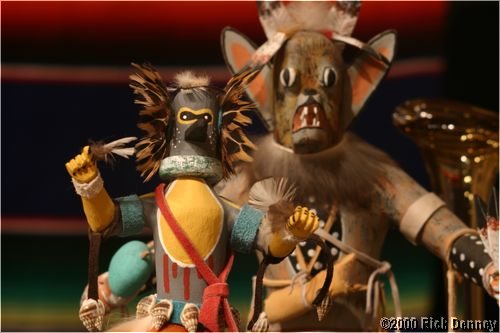 |
Overall effect: Pleasing
|
| 120/2.8 Zeiss Jena MC-Biometar |
Not included due to faulty aperture. | |
| 75-150/3.5 Nikon Series E (at ~135) |
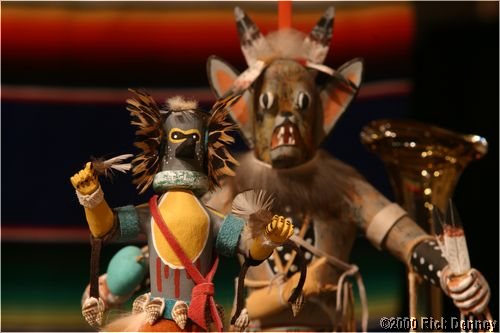 |
Overall effect: Pleasing
|
| 120/2.8 Arsenal Vega MC |
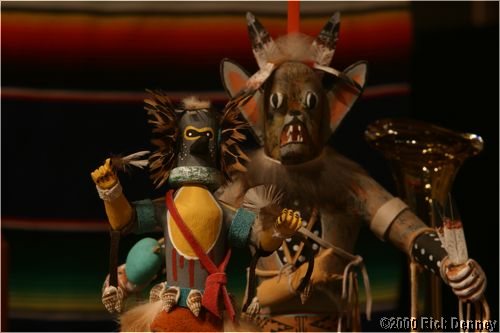 |
Overall effect: Neutral,
background rendering too sharp (this would be enhanced
apparently depth of field, and would be desirable for most
applications, though)
|
| 70-200/4L Canon (at ~135) |
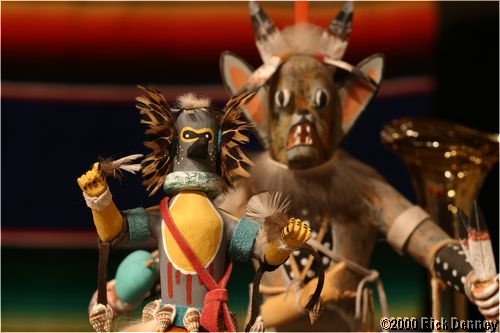 |
Overall effect: Pleasing
|
| 135/2.8 Canon (no SF) |
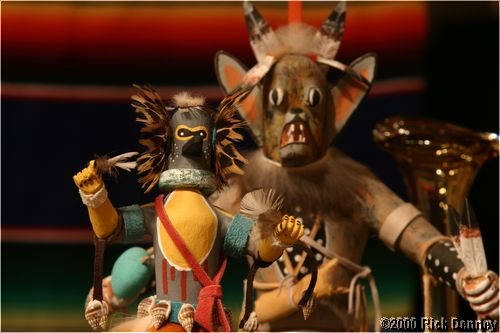 |
Overall effect: Pleasing
|
| 85/2 Jupiter |
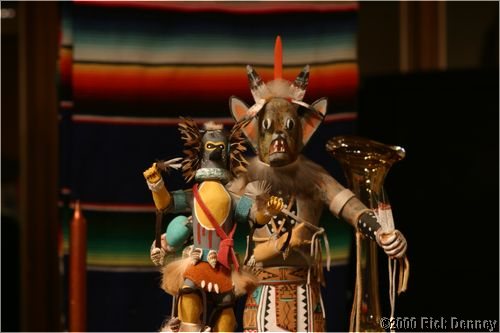 |
Overall effect: Pleasing
|
Test Scenario 3, Background Doll More Distant, f/4
This scenario gives a better notion of how smooth the background rendering is with each lens.
| 135/3.5 Zeiss Jena MC-Sonnar |
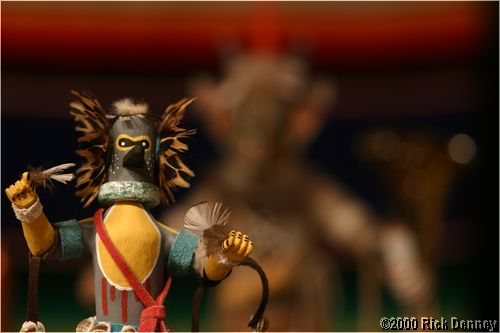 |
Edge: Very slight bright-line Double-line: None Aperture shape: None Overall effect: Pleasing, perhaps the best in this test scenario. |
| 139/4.5 Bausch and Lomb Tessar |
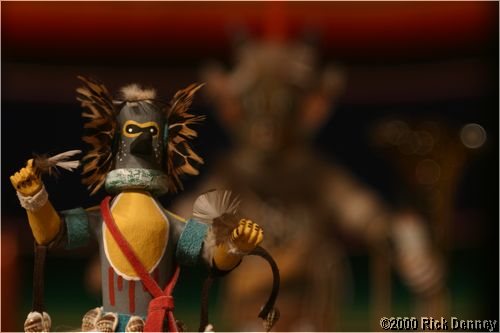 |
Edge: Pronounced bright-line Double-line: Apparent Aperture shape: None Overall effect: Yup, clumpy. Doesn't have the smoothness of the Sonnar.
|
| 120/2.8 Zeiss Jena MC-Biometar |
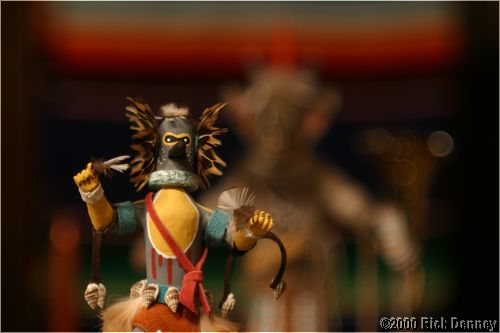 |
Edge: Pronounced bright-line Double-line: Apparent Aperture shape: None Overall effect: Distracting |
| 75-150/3.5 Nikon Series E (at ~135) |
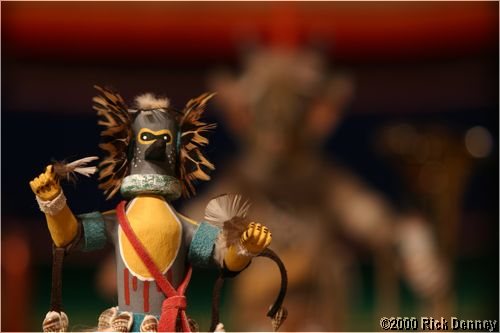 |
Edge: Very slight bright-line Double-line: None Aperture shape: Slightly oval (vignetting?) Overall effect: Pleasing
|
| 120/2.8 Arsenal Vega MC |
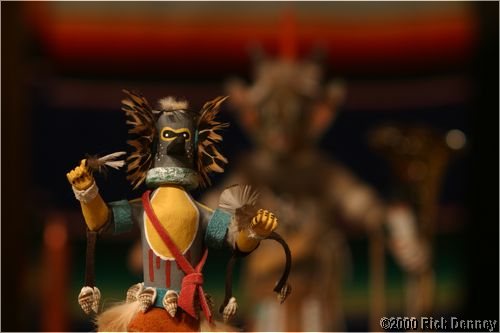 |
Edge: Slight bright-line Double-line: Apparent Aperture shape: Slight Overall effect: Not nearly as smooth as most in the test.
|
| 70-200/4L Canon (at ~135) |
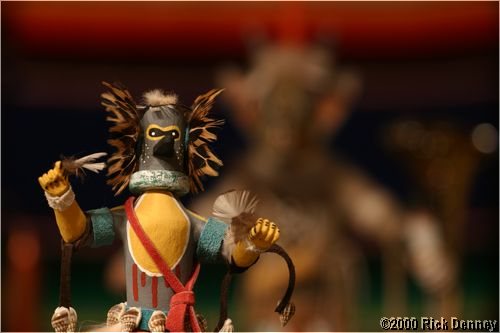 |
Edge: Slight bright-line Double-line: Slight Aperture shape: None (lens is wide open) Overall effect: Pleasing, not quite as smooth as the Sonnar
|
| 135/2.8 Canon (no SF) |
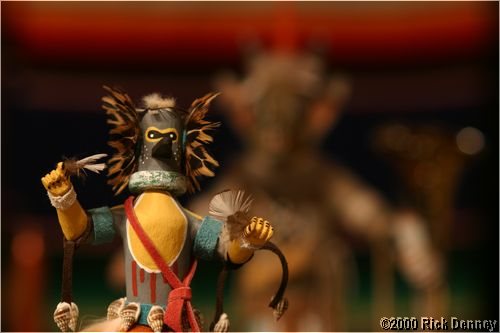 |
Edge: Slight bright-line Double-line: Slight Aperture shape: Slight Overall effect: Neutral, not quite as good as the 70-200/4L
|
| 85/2 Jupiter (at f/2 to produce same apparent focus) |
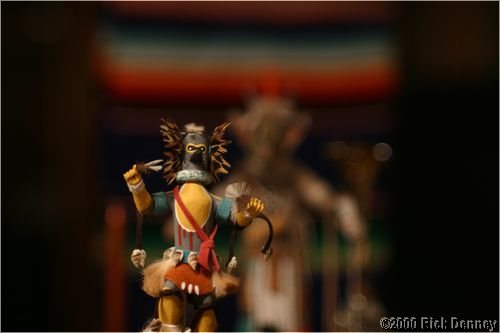 |
Edge: Pronounced bright-line Double-line: Apparent Aperture shape: None Overall effect: Supposedly a Sonnar design, but no match for the Sonnar in this test.
|
Test Scenario 3, Sonnar 180 and Canon 70-200, at f/4
Think a zoom lens can't have good bokeh? Think again.
| 180/2.8 Zeiss Jena MC-Sonnar |
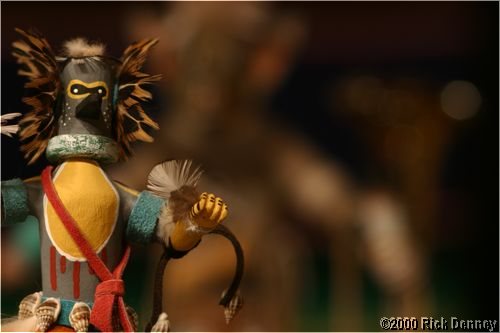 |
Edge: The highlight fades at
the edge, but with a very slight bright edge on one side. Double-line: None Aperture shape: None Overall effect: This is the classic Sonnar look, with a very smooth rendering of the background. |
| 70-200/4L Canon (at ~200) |
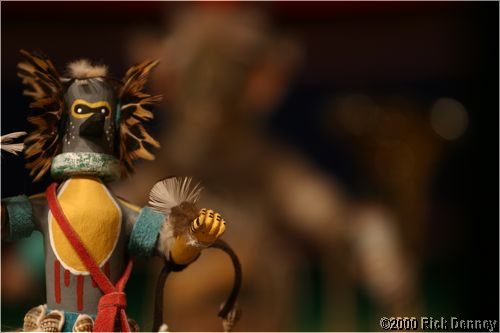 |
Edge: Faded edge Double-line: None Aperture shape: Slight oval. Overall effect: Quite pleasing, and outstanding for a zoom, even a high-end zoom. But the Sonnar has the edge (or, rather, the lack of edge). In the face of the far doll, there are some edges that are smoother in the Sonnar image |
Test Scenario 3, All Lenses Faster Than f/4, Wide Open.
Think a faster lens always provides better bokeh? Think again. But if it's faster by a large margin, the difference in focus may overcome a difference in bokeh. The best way to get the same effect as a larger aperture, though, is to back up and use a longer lens.
| 180/2.8 Zeiss Jena MC-Sonnar |
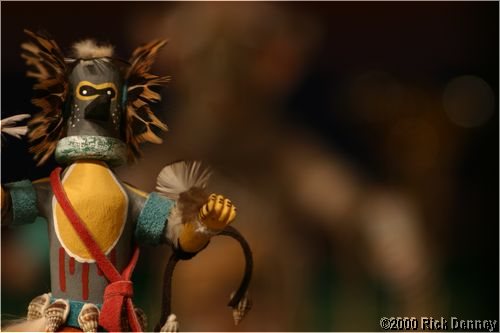 |
Edge: Faded Double-line: None Aperture shape: None Overall effect: Wide, smooth brush. The best of all the lenses (but comparisons are hard due to longer focal length) |
| 135/2.8 Canon (no SF) |
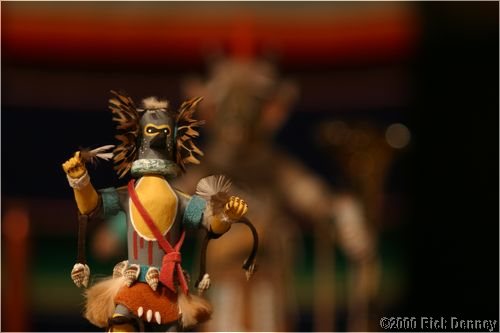 |
Edge: Slight bright-line Double-line: Apparent Aperture shape: None Overall effect: No match for either Sonnar. Even though this lens is faster than the 135/3.5 Sonnar, the background rendering is not as smooth.
|
| 120/2.8 Arsenal Vega MC
|
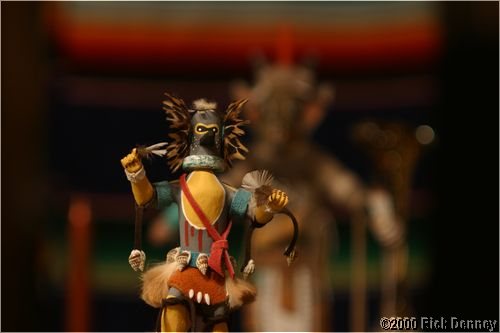 |
Edge: Moderate bright-line Double-line: Apparent Aperture shape: None Overall effect: Distracting |
| 120/2.8 Zeiss Jena MC-Biometar
|
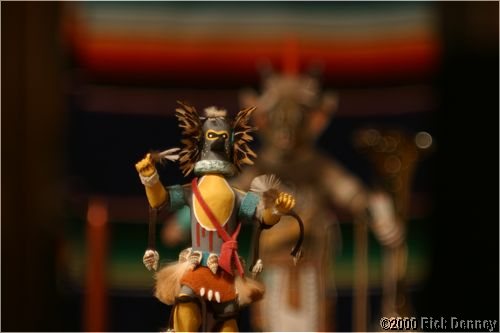 |
Edge: Pronounced bright-line Double-line: Significant Aperture shape: None Overall effect: Distracting; worse than the Vega. This is surprising--the Biometar is often the choice for those who don't like the Vega's bokeh. |
| 135/3.5 Zeiss Jena MC-Sonnar
|
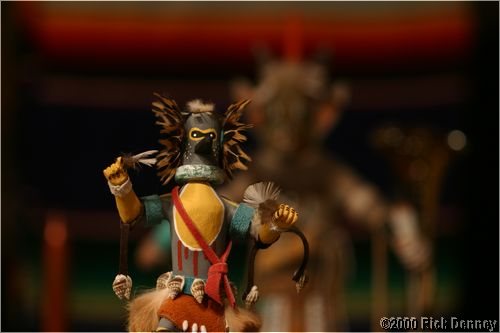 |
Edge: Very slight bright-line Double-line: None Aperture shape: None Overall effect: Very smooth, and the best of this test (except for the 180 Sonnar), despite being the slowest lens in this test scenario.
|
What have we learned?
- Bokeh has several components, including edge effects around out-of-focus highlights and false edges in the rendering of out-of-focus details.
- Bokeh rendering is not the same in all situations, and some lenses will be better than others in some situations and worse in other situations. The Vega in this test has produced some really ugly bokeh, not consistent with these results. Lens bokeh is not a single value, and each lens requires considerable experience to understand where it is good and where it is not.
- Wider apertures do not necessarily improve bokeh.
- Specular highlights and other out-of-focus bright spots don't tell the whole bokeh story.
- Longer focal lengths improve bokeh. If smooth rendering is important, get a longer lens and back up.
- Double-gauss designs aren't necessarily bad, but the bad ones are really bad.
- Sonnar designs don't necessarily have better bokeh, but they have the potential.
- Reputation for good bokeh (e.g., the Jupiter) don't always show in actual results.
- Lens complexity seems to have little bearing on bokeh. Lens design, however, is paramount.
- Apertures shapes are not really an issue with bokeh, especially near wide open. In none of these tests was aperture shape the main determinant in apparent bokeh quality. So, we should stop counting aperture blades. The lens with the most aperture blades was the B&L Tessar, but it had uniformly the worst bokeh.
- Bokeh is subjective, but it is not an illusion.
- Canon knows how to design a zoom lens. Nikon didn't do too badly, either.
- The Biometar is NOT better than the Vega, at least in these tests.
- The inexpensive Zeiss Jena Sonnars provide a lot of bokeh quality for the buck.